Amoeba
An amoeba (pronounced uh-MEE-buh) is any of several tiny, one-celled protozoa in the phylum (or primary division of the animal kingdom) Sarcodina. Amoebas live in freshwater and salt water, in soil, and as parasites in moist body parts of animals. They are composed of cytoplasm (cellular fluid) divided into two parts: a thin, clear, gel-like outer layer that acts as a membrane (ectoplasm); and an inner, more watery grainy mass (endoplasm) containing structures called organelles. Amoebas may have one or more nuclei, depending upon the species.
The word amoeba comes from a Greek word meaning "to change." The amoeba moves by continually changing its body shape, forming extensions called pseudopods (false feet) into which its body then flows. The pseudopods also are used to surround and capture food—mainly bacteria, algae, and other protozoa—from the surrounding water. An opening in the membrane allows the food particles, along with drops of water, to enter the cell, where they are enclosed in bubblelike chambers called food vacuoles. There the food is digested by enzymes and absorbed into the cell. The food vacuoles then disappear. Liquid wastes are expelled through the membrane.
Water from the surrounding environment flows through the amoeba's ectoplasm by a process called osmosis. When too much water accumulates in the cell, the excess is enclosed in a structure called a contractile vacuole and squirted back out through the cell membrane. The membrane also allows oxygen to pass into the cell and carbon dioxide to pass out.
The amoeba usually reproduces asexually by a process called binary fission (splitting in two), in which the cytoplasm simply pinches in half
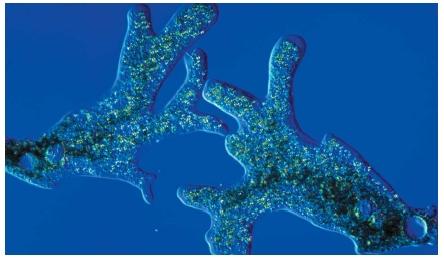
and pulls apart to form two identical organisms (daughter cells). This occurs after the parent amoeba's genetic (hereditary) material, contained in the nucleus, is replicated and the nucleus divides (a process known as mitosis). Thus, the hereditary material is identical in the two daughter cells. If an amoeba is cut in two, the half that contains the nucleus can survive and form new cytoplasm. The half without a nucleus soon dies. This demonstrates the importance of the nucleus in reproduction.
Some amoebas protect their bodies by covering themselves with sand grains. Others secrete a hardened shell that forms around them that has a mouthlike opening through which they extend their pseudopods. Certain relatives of the amoeba have whiplike organs of locomotion called flagella instead of pseudopods. When water or food is scarce, some amoebas respond by rolling into a ball and secreting a protective body covering called a cyst membrane. They exist in cyst form until conditions are more favorable for survival outside.
Words to Know
Asexual reproduction: Any reproductive process that does not involve the union of two individuals in the exchange of genetic material.
Cytoplasm: The semifluid substance of a cell containing organelles and enclosed by the cell membrane.
Organelle: A functional structure within the cytoplasm of a cell, usually enclosed by its own membrane.
Osmosis: The movement of water across a semipermeable membrane from an area of its greater concentration to an area of its lesser concentration.
Protozoan: A single-celled, animal-like organism.
Pseudopod: From pseudo, meaning "false," and pod, meaning "foot"; a temporary extension from a cell used in movement and food capture.
Some common species of amoebas feed on decaying matter at the bottom of freshwater streams and stagnant ponds. The best-known of these, Amoeba proteus, is used for teaching and cell biology research. Parasitic species include Entamoeba coli, which resides harmlessly in human intestines, and Entamoeba histolytica, which is found in places where sanitation is poor and is carried by polluted water and sewage. Infection with Entamoeba histolytica causes a serious intestinal disease called amoebic dysentery, marked by severe diarrhea, fever, and dehydration.
[ See also Cell ; Protozoa ; Reproduction ]
as the liver, spleen or lungs? Thank you very much!
thank you...tom
Thanks Again!
York. Carly1@gmail.com
thx again,
Anymous
I hope that you will read this to know that I am really grateful for this info. Really interesting and really helps!
:)