Ecosystem
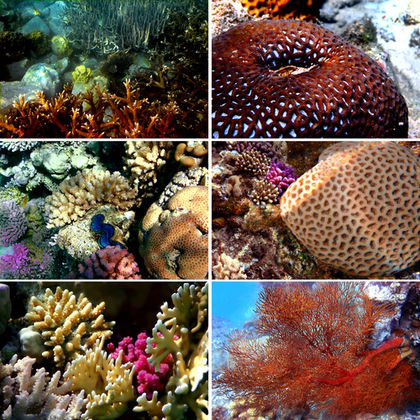
An ecosystem (or ecological system) is a collection of communities of organisms and the environment in which they live. Ecosystems can vary greatly in size. Some examples of small ecosystems are tidal pools, a home garden, or the stomach of an individual cow. Larger ecosystems might encompass lakes, agricultural fields, or stands of forests. Landscape-scale ecosystems encompass larger regions, and may include different terrestrial (land) and aquatic (water) communities. Ultimately, all of Earth's life and its physical environment could be considered to represent an entire ecosystem, known as the biosphere.
Ecologists often invent boundaries for ecosystems, depending on the particular needs of their work. (Ecologists are scientists who study the relationships of organisms with their living and nonliving environments.) For example, depending on the specific interests of an ecologist, an ecosystem might be defined as the shoreline vegetation around a lake, or the entire lake itself, or the lake plus all the land around it. Because all of these units consist of organisms and their environment, they can properly be considered to be ecosystems.
The raw materials of an ecosystem
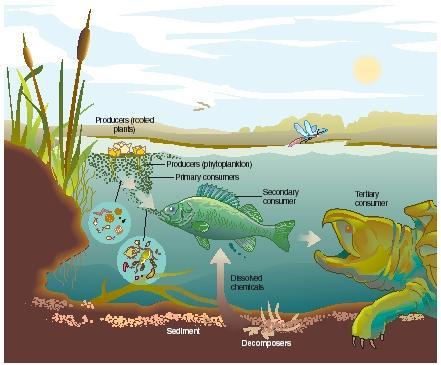
All ecosystems have a few basic characteristics in common. They use energy (usually provided by sunlight) to build complex chemical compounds out of simple materials. At the level of plants, for example, carbon dioxide and water vapor are combined with the energy of sunlight to produce complex carbohydrates, such as starches (this process is known as photosynthesis). As plants (producers) are consumed by other organisms, more complex substances are manufactured in their bodies, and energy is passed upward through the food web.
The flow of energy in an ecosystem occurs in only one direction: it is always consumed by higher levels of organisms in a food web. As a result, each level of a food web contains less energy than the levels below it. By contrast, nutrients can flow in any direction in an ecosystem. When plants and animals die, the compounds of which they are formed are decomposed by microorganisms (decomposers), returned to the environment, and are recycled for use again by other organisms.
One of the greatest challenges facing humans and their civilization is to develop an understanding of the fundamentals of ecosystem organization, how they function and how they are structured. This knowledge
is absolutely necessary if humans are to design systems that allow for the continued use of the products and services of ecosystems. Humans are sustained by ecosystems, and no alternative to this relationship exists.
[ See also Biosphere ; Gaia hypothesis ]
=) T.Y
Your help will be highly appreciated Thanks
Thanks