Rocks
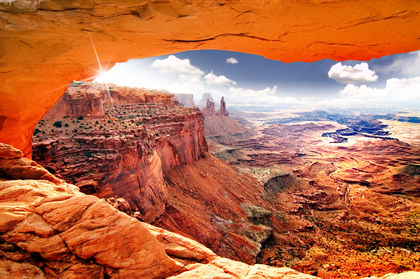
Rocks are composed of minerals, which are natural inorganic (nonliving) substances with specific chemical compositions and structures. A rock may consist of many crystals of one mineral or combinations of many minerals. Hundreds of different kinds of minerals make up hundreds of different kinds of rocks. Geologists, scientists who study Earth and rocks, divide rocks into three main groups: igneous rocks, sedimentary rocks, and metamorphic rocks. These distinctions are made on the basis of the types of minerals in the rock, the shapes of individual mineral grains, and the overall texture of the rock. All of these properties indicate the environment, pressure, and temperature in which the rock formed.
Igneous rock
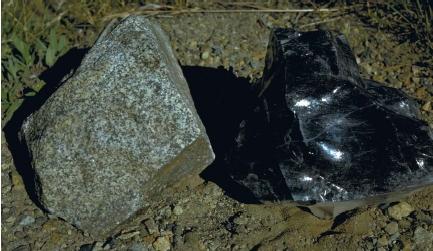
The first rocks on Earth were igneous rocks. Igneous rocks are formed by the cooling and hardening of molten material called magma. The word igneous comes from the Latin word ignis, meaning "fire." There are two types of igneous rocks: intrusive and extrusive. Intrusive igneous rocks form within Earth's crust: the molten material rises, filling any available crevices in the crust, and eventually hardens. These rocks are not visible until Earth above them has eroded away. A good example of intrusive igneous rock is granite. Extrusive igneous rocks form when the magma pours out onto Earth's surface or erupts at Earth's surface from a volcano. Once on the surface (where it is called lava), it begins to cool and the minerals in the rock crystallize or grow together so that the individual crystals lock together. Extrusive rocks are also called volcanic rocks. Basalt, formed from hardened lava, is the most common extrusive rock. Obsidian, a black, glassy rock, is also an extrusive rock.
Words to Know
Igneous rock: Rock formed from the cooling and hardening of magma.
Lava: Molten rock that occurs at the surface of Earth, usually through volcanic eruptions.
Magma: Molten rock found below the surface of Earth.
Metamorphic rock: Rock formed by transformation of preexisting rock through changes in temperature and pressure.
Mineral: A naturally occurring, inorganic substance with a definite chemical composition and structure.
Rock cycle: Processes through which rocks change from one type to another, typically through melting, metamorphism, uplift, weathering, burial, or other processes.
Sedimentary rock: Rock formed from compressed and solidified layers of organic or inorganic matter.
Weathering: Natural process that breaks down rocks and minerals at Earth's surface into simpler materials (sediment) by physical (mechanical) or chemical means.
Essentially, Earth's continents are slabs of granite sitting on top of molten rock. The crustal plates of Earth are continually shifting, being torn open by faults and altered by earthquakes and volcanoes. New igneous material is continually added to the crust, while old crust falls back into Earth, sometimes deep enough to be remelted. Igneous rocks are the source of many important minerals, metals, and building materials.
Sedimentary rock
Sedimentary rocks are those produced by the accumulation of sediments. These may be fine rock particles or fragments, skeletons of microscopic organisms, or minerals leached from rocks. Rock fragments and leached minerals are created through weathering, a natural process that breaks down rocks and minerals at Earth's surface into simpler materials by physical (mechanical) or chemical means.
Wind, water, ice, gravity, temperature changes, or a combination of these are all physical actions that break down preexisting rocks. Chemical weathering represents a second stage of rock disintegration in which small pieces of rock produced by physical weathering are then further
broken apart by chemical processes. Acid reactions are a common form of chemical weathering, and the most common such reactions occur when carbon dioxide and sulfur dioxide in the air react with water to form weak carbonic and sulfuric acid. Both of these acids have the ability to attack many kinds of rocks, changing them into other forms. For example, when carbonic acid reacts with limestone, it produces calcium bicarbonate.
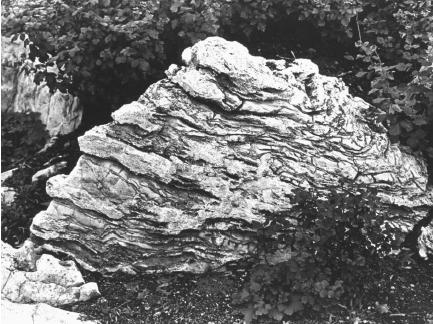
The sediments created by weathering and the decay of organisms are then transported and deposited by wind, water, or ice. Over long periods of time, layer upon layer of sediments are deposited on top of each other and their own weight causes them to compress and harden into sedimentary rock. The horizontal layers of sedimentary rock are called strata. Common sedimentary rocks include shale, sandstone, and limestone.
Sedimentary rocks are the only rocks in which fossils can be preserved. The elevated temperatures and pressures needed to form both igneous and metamorphic rocks destroy fossils and organic remnants. The presence of fossils and the types of fossil organisms in a rock provide clues about the environment and age of sedimentary rocks. For example, fish fossils in sedimentary rock indicate that the sediments that make up the rock were deposited in a lake, river, or marine environment. By establishing the environment of the fossils in a rock, scientists learn more about the conditions under which the rock formed.
Metamorphic rock
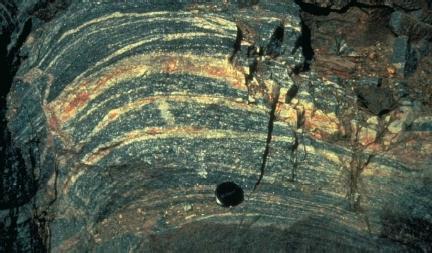
Metamorphic rock is rock that has changed from one type of rock into another. The word metamorphic comes from Greek and means "of changing form." Metamorphic rock is produced from igneous, sedimentary, or even other metamorphic rocks. Most of Earth's crust is made up of metamorphic rock. Igneous and sedimentary rocks become metamorphic rock as a result of intense heat from magma and pressure from burial within Earth. Although the rock undergoes extreme heat and a great deal of pressure, it does not melt. If the rock melted, it would become igneous and not metamorphic rock. Instead, the heat and pressure combine to change the mineral makeup of the rock. Essentially, metamorphic rocks are made of the same minerals as the original rock, but the various minerals have been rearranged to make a new rock.
There are two basic types of metamorphic rock: regional and thermal. Regional metamorphic rock, found mainly in mountainous regions, is formed by pressure. Different amounts of pressure produce different types of rock. The greater the pressure, the more drastic the change (also, the deeper the rock the higher the temperature, which adds to the potential for diverse changes). For example, a pile of mud can turn into shale (a fine-grained sedimentary rock) with relatively low pressure, about 3 miles (5 kilometers) down into Earth. With more pressure and some heat, shale can transform into slate and mica. Carried even deeper, slate transforms into schist (pronounced shist) and then gneiss (pronounced nice).
Thermal metamorphic rock, also called contact metamorphic rock, is formed by considerable pressure and, more important, intense heat. When molten rock pushes up into Earth's crust, the incredible pressure behind it forces the molten rock into any empty space. The accompanying intense heat causes the surrounding rock to completely recrystallize, forming a new rock. An example of this type of thermal metamorphic rock is marble, which is actually limestone whose calcite has recrystallized. Sandstone made mostly of quartz fragments recrystallizes into quartzite. Thermal metamorphic rocks are not as common or plentiful as regional metamorphic rocks.
The rock cycle
The rock cycle depicts how the three main rock types can change from one type to another. All rocks exposed at Earth's surface undergo weathering, forming sediments that can be deposited to form sedimentary rocks. As sedimentary rocks are buried beneath more sediment, they are subjected to increases in both pressure and temperature, which can result in metamorphism and the formation of metamorphic rock. If the temperature of metamorphism is extremely high, the rock might melt completely and later recrystallize as an igneous rock. Rocks can move through the rock cycle along other paths, but uplift or burial, weathering, and changes in temperature and pressure are the primary causes of changes in rocks from one type to another.
I found a lot of information i needed to know on how the rocks change into other rocks for my science report!!!!
THANK YOU SO MUCH FOR MAKING THIS WEBSITE!!!!
keep on dancin'
thanks!!,
briannna
i really love it sooooooo much...
THANKZS!!
i used this information for my science project
thanks
thankss =) nice website!!
good information
Awesome!
shiki_rima03
for giving me the answers in my assignment............
that's all..
thank's again..
i saw it clearly the types of rocks.......
and i hope there is so many improvements to your website...
saved me lot of time
you got everything i needed
in science im learning rocks and menerals and these are good infromations