Tumor
A tumor is an abnormal growth of tissue. Also known as a neoplasm (meaning "new formation"), a tumor can be either benign (not serious or harmful) or malignant (cancerous or deadly). Either type may require therapy to remove it or reduce its size.
It is not known what triggers a tumor's abnormal growth. The body normally creates cells only at a rate needed to replace those that die or to aid an individual's growth and development. The growth of a tumor, however, is unregulated by normal body control mechanisms.
Benign and malignant tumors
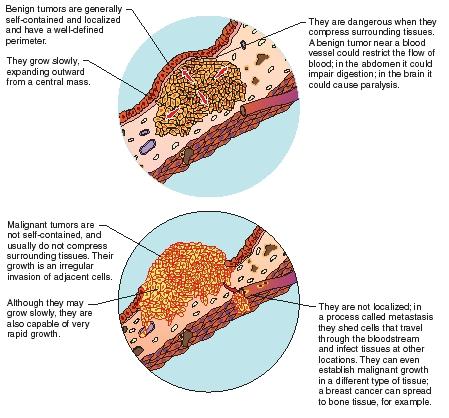
A benign tumor is a well-defined growth with smooth boundaries that simply grows in diameter. This can be harmful if the tumor compresses the surrounding tissue against a hard surface in the body. A benign brain tumor that compresses brain tissue against the skull or the bony floor of the cranium can result in paralysis, loss of hearing or sight, dizziness, and other ailments. A tumor growing in the abdomen can compress the intestine and interfere with digestion. It also can prevent the proper functioning of the liver or pancreas. The benign tumor usually grows at a relatively slow pace and may stop growing for a time when it reaches a certain size.
Words to Know
Benign: A slow-growing, self-contained tumor that is not seriously harmful.
Biopsy: The surgical removal of a small part of a tumor, which is then studied under a microscope to determine whether it is benign or malignant.
Chemotherapy: Use of powerful chemicals to kill cancer cells in the human body.
Malignant: A usually fast-growing, often fatal tumor that invades surrounding tissue and sheds cells that spread throughout the body, creating new tumors.
Metastasis: Spreading of a cancerous growth by shedding cells that grow in other locations.
Radiation therapy: Use of radioactive substances to kill cancer cells in the human body.
A malignant tumor may grow quite rapidly and can be fatal. It usually has irregular boundaries and invades the surrounding tissue instead of pressing it aside. Most important, this cancer also sheds cells that travel through the bloodstream, starting new tumor growth at other locations in the body. This process is called metastasis (pronounced me-TAS-ta-sis). The cancerous cells can establish a cancer in tissue that is different from the original cancer. A breast cancer could spread to bone tissue or to liver tissue.
Medical approaches
Benign tissue is distinctly different from cancer tissue. However, it is difficult to determine whether a tumor is benign or malignant without surgically removing a sample of it and studying the tissue under the microscope. This sampling is called a biopsy (pronounced BY-op-see).
A benign tumor can be removed surgically if it is in a location that a surgeon can reach. A tumor growing in an unreachable area of the body can be treated using radiation (by which the patient is administered radioactive substances that target a specific area and destroy cells there). Another method is to insert thin probes into the tumor and freeze it with liquid nitrogen. This operation is called cryosurgery (pronounced cry-o-SUR-jer-ee).
A malignant tumor may be removed surgically. However, if the tumor has been growing for some time and has begun to metastasize or spread, the patient also may require treatment with powerful chemicals
to kill any stray cells. This treatment is called chemotherapy (pronounced key-moe-THER-a-pee).
[ See also Cancer ]
The surgery went well, they took out the tumor and found no cancer. However, they took half of the thyroid, and now my friend is very angry that she even had it removed because it turned out not to be cancerous. Were they wrong to take it out. It grew slowly over years, and sometimes it gave her a little pain.
Can you tell me anything that might help her view of the situation, or should she be taking action against the Doctor who insisted on taking out the tumor?
I'm assuming they had reason to believe the tumor was dangerous, but I'd love some information that might help her calm down, and realize it was for the best.
If so would there be symptoms? I just have no fam hx of breast ca; am a 36A (making mammograms difficult if you know what i mean). I honestly am thinking about watching for 3 years in a consistent routine mammo manner and not jump the gun for follow up mammo and US. Please tell me if i am wrong, or if the new facility wants to see if they can gets as much out of me as the other place did? I have a high deductible health plan and this will be $700-$99 or more out of my pocket. All because i let sociaty scare me silly about a bunch of tests that are not even necessary since thar area was already deemed benign, Sorry for the synicsym but I have a 10 yar old and life is on the brink of becoming her world - i don't want to muk it up for her, Thanks for any opinions you have for me - the more the better, Zena
MANY THANKS
WENDY